How To Handle More Leads When Your Season Gets Busy
Every home service business says they want more leads.
More calls. More estimates. More jobs.
Until it actually happens.
Then the phones start ringing, the schedule fills up, and instead of growth, things feel chaotic. Jobs get rushed. Calls get missed. Margins shrink. Stress goes up.
This is where most businesses get it wrong.
Busy does not equal growth.
Busy exposes your systems.
THE Home Service Hotseat episode 15, showcases how Michael Grigery and Jonathan Maynard break down what really happens when demand increases and why most companies waste the opportunity.
If you want to know how to handle more leads without breaking your business, this is where it starts.
Why Busy Season Doesn’t Automatically Mean Growth

When demand spikes, most owners assume success is inevitable.
More leads should mean more revenue.
But in reality, busy season amplifies whatever is already broken.
- Weak scheduling becomes bottlenecks
- Poor sales process becomes lost revenue
- Lack of pricing discipline kills margins
- No systems creates chaos
You do not rise to the level of demand.
You fall to the level of your systems.
That is why two companies can get the same number of leads and have completely different outcomes.
One grows. One burns out.
The First Problem: You’re Not Set Up to Handle More Leads
Most businesses think they have a lead problem.
They don’t. They have a capacity and conversion problem.
When leads increase, three things immediately break:
1. Response Time Slows Down
Calls go unanswered.
Voicemails stack up.
Follow-ups get delayed.
Speed matters!
The company that responds first usually wins the job.
If you are slow, you are not competing on quality. You are losing on timing.
2. Scheduling Becomes Reactive
Instead of controlling the schedule, the schedule controls you.
- Jobs get stacked inefficiently
- Drive time increases
- Crews get overwhelmed
- Jobs run late
This kills both profitability and customer experience.
3. Sales Process Gets Sloppy
When you are busy, you stop selling properly.
You:
- Rush estimates
- Skip upsells
- Discount to close faster
- Forget follow-ups
You close jobs, but you lose margin.
And margin is what actually grows the business.
How to Handle More Leads Without Losing Control
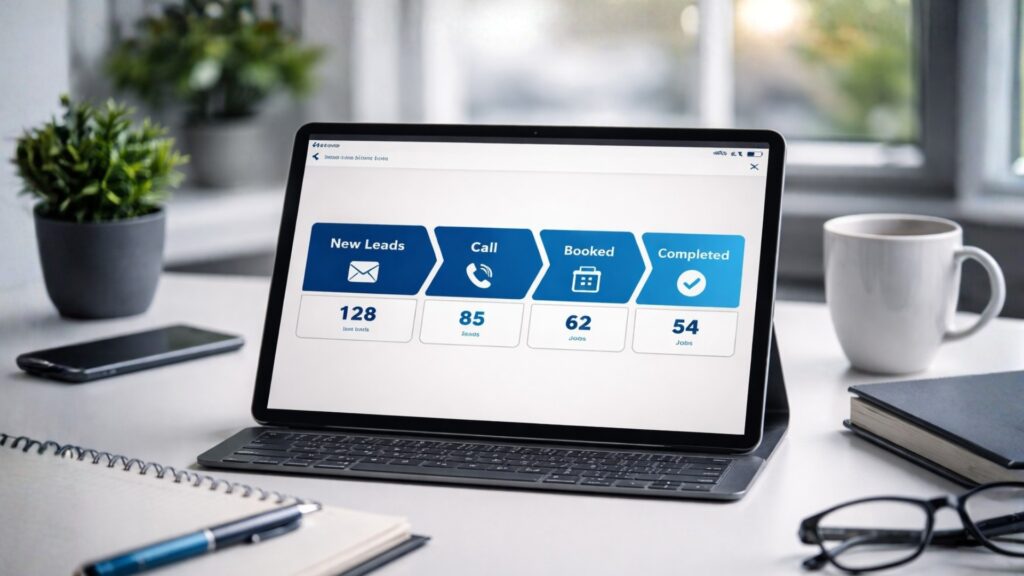
If you want to turn busy season into real growth, you need structure.
Not more effort. Not more hustle. Structure.
1. Speed Wins First
You need a system for rapid response.
That means:
- Calls answered live whenever possible
- Missed calls returned within minutes, not hours
- Estimates scheduled immediately
If you are not first, you are competing uphill.
Fast response is one of the simplest home service business growth strategies, and most companies still get it wrong.
2. Protect the Schedule
Your schedule is your profit engine.
When it breaks, everything breaks.
To fix this:
- Cluster jobs by location
- Avoid overbooking “just in case”
- Build realistic time buffers
- Prioritize high-value jobs
Busy companies often try to say yes to everything.
Strong operators protect capacity.
Because when your schedule is tight and controlled, your margins stay intact.
3. Standardize the Sales Process
When leads increase, you cannot rely on memory or instinct.
You need a repeatable sales process.
That includes:
- Clear pricing structure
- Defined estimate flow
- Consistent upsell opportunities
- Follow-up system for unsold jobs
If your team is “winging it,” you are leaving money on the table.
Every lead should go through the same process.
That is how you turn volume into revenue.
4. Stop Discounting Under Pressure
This is one of the most common mistakes.
When things get busy, owners feel pressure to:
- Move faster
- Close quicker
- Keep jobs flowing
So they discount.
That is backwards.
Demand is high. That is when pricing should hold or improve.
If your calendar is full, your prices are probably too low.
Busy season should increase profitability, not reduce it.
5. Focus Beats Expansion
When things start working, many owners make a critical mistake.
They expand too early.
- Add new services
- Chase new markets
- Try new offers
- Start side ventures
This splits focus.
Instead of maximizing what is already working, they dilute it.
The result is:
More complexity.
Less control.
Lower profit.
If you want real growth, double down before you branch out.
The Hidden Danger of Getting Busy

Busy feels productive. It is not always profitable.
Without systems, busy leads to:
- Burnout
- Mistakes
- Customer complaints
- Team frustration
- Lower margins
The goal is not to be busy.
The goal is to be efficient, profitable, and controlled.
That requires discipline.
The Operators Advantage
The difference between average companies and high-performing ones is not demand.
Strong operators:
- Respond faster
- Schedule smarter
- Sell consistently
- Price confidently
- Stay focused
They do not chase more leads.
They maximize the leads they already have.
Turning Busy Into Growth

If you want to turn busy season into real growth, focus on three things:
1. Conversion
More leads mean nothing if you cannot convert them.
Track:
- Call booking rate
- Estimate to job rate
- Follow-up success
Improve conversion, and revenue grows without more marketing.
2. Capacity
Know exactly how much work your team can handle.
Do not guess.
Track:
- Jobs per crew per day
- Average job duration
- Utilization rate
When you know your capacity, you can control your schedule.
3. Margin
Revenue is not growth. Profit is.
Track:
- Labor percentage
- Average ticket
- Upsell rate
- Rework
Busy season should increase profit, not just revenue.
The Real Shift
Most owners think the problem is getting more leads.
The real problem is what happens after the lead comes in.
If you cannot handle more leads, more marketing will not fix your business.
It will just amplify the chaos.
That is why the best home service business growth strategies focus on operations first, marketing second.
Final Thought
When your home service business gets busy, you are at a fork in the road.
You can:
- Get overwhelmed
- Stay reactive
- Burn out your team
- Lose margin
Or you can:
- Install systems
- Control the schedule
- Standardize sales
- Protect pricing
- Build momentum
Busy is not the goal.
Controlled growth is.
Turn Your Busy Season Into Real Growth

If your phones are ringing but your business feels chaotic, the problem is not demand. It is structure.
Book a 30-minute Operations Strategy Call and get a clear plan to:
- Handle more leads without losing control
- Improve conversion and scheduling
- Protect your margins during busy season
Listen to the full episode: