Home Service Leadership: Why Companies Stop Growing
Building a home service business that scales is about more than working harder or adding more trucks. It all starts with a strong vision, leadership and culture. Specifically, the environment leaders install that shape behavior when nobody’s looking.
Most owners do not hit a growth ceiling because of marketing or pricing. They stall because leadership is informal, standards are inconsistent, and decisions bottleneck at the top. The business runs on effort instead of structure.
Episode 12 of THE Home Service Hotseat addresses this directly. Michael and Jonathan explain why strong operators win by building leadership systems, not by micromanaging people. They break down how clarity, scoreboards, and leadership cadence create teams that perform without constant supervision.
“If every decision still needs you, you don’t have a team. You have bottlenecks.”
If this feels familiar, you are not alone. Most home service businesses are not broken. They’re missing a world-class leader
This article turns Episode 12 into a practical leadership framework you can apply immediately. Systems that help you recruit better people, develop leaders, and scale without burning out.
Why Home Service Businesses Hit a Leadership Ceiling
Every home service company eventually reaches a point where effort stops producing results. The owner works longer hours, problems feel heavier, and growth slows even as spend increases.
This is the leadership ceiling.
When the business depends on the owner to decide, approve, and fix everything, growth becomes fragile. Stress increases. Quality slips. Good people leave.
Strong operators break through this ceiling by replacing reaction with structure. They build businesses that run on standards instead of personalities.
The Shift from Owner Operator to Business Operator in Home Services
Owner operator thinking sounds like:
- I need to stay close to everything
- My team needs me to decide
- Problems get fixed when I step in
Operator thinking looks like:
- The system decides
- Leaders are developed, not rescued
- Problems surface early through data
This shift changes everything. When the system leads, people stop waiting and start owning outcomes.
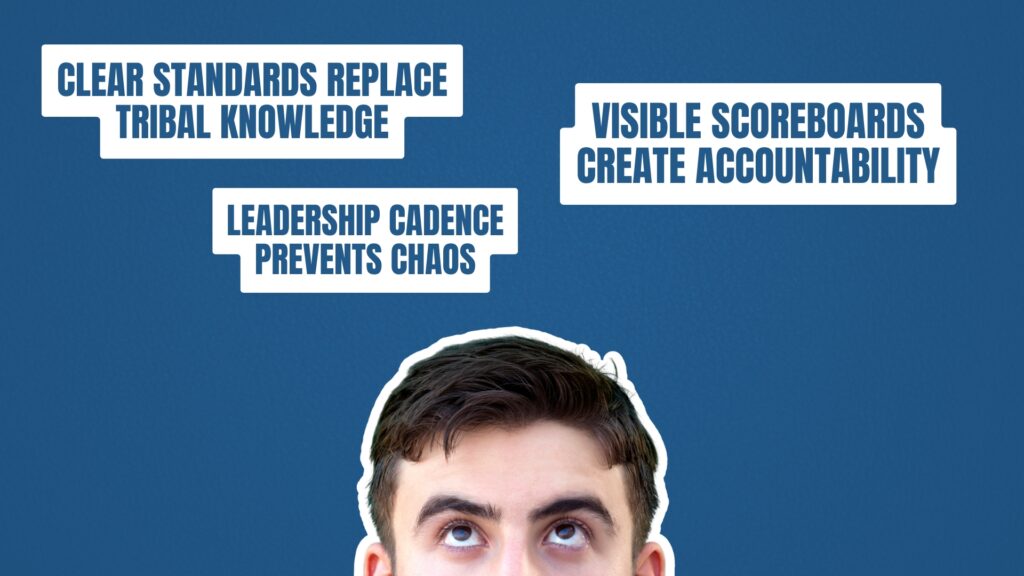
The Three Pillars of Home Service Leadership
High performing home service companies are built on three non negotiable pillars. Remove one and the operation eventually collapses.
Clear Standards Replace Tribal Knowledge
People cannot meet expectations that are undefined.
Standards must be written, observable, and measurable. This includes job quality, safety, communication, appearance, and customer experience.
If a standard only exists in your head, it does not exist.
Visible Scoreboards Create Accountability
When performance is invisible, accountability feels personal. When performance is visible, accountability feels fair.
“When performance is visible, accountability stops being emotional.”
Scoreboards remove guessing. They give teams clarity on how they are winning or losing each week.
Leadership Cadence Prevents Chaos
Leadership is not an event. It is a rhythm.
Strong operators run predictable cadence:
- Daily huddles
- Weekly tracking scorecards
- Monthly one-on-one meetings
- Quarterly planning
When cadence disappears, confusion fills the gap.
Why Teams Underperform Without Knowing It
When expectations are unclear and results are not measured, people default to what feels right. Guessing creates inconsistency. Inconsistency destroys trust and results.
Data removes emotion from leadership conversations. When numbers speak, leaders coach instead of argue.

The Operator’s Scorecard for Home Service Leadership
Capacity and Utilization
Scheduled hours versus produced hours. This shows whether trucks are being used effectively.
Quality Signals
Rework percentage, callbacks, and review velocity. Quality problems show up here first.
Sales Conversion
Lead to estimate to job. This reveals whether the issue is demand or execution.
Labor Efficiency
Labor percentage by service line and drive time ratio. This protects margin.
Safety and Risk
Incidents, near misses, and damage reports. Culture always shows up here.
People Health
Attendance, training completion, and recognition frequency.
“If you want better behavior, measure it weekly.”
Leadership Is a Practice, Not a Personality.

Strong leaders don’t rely on motivational speeches alone. Structure creates fairness, consistency, predictability, and trust.
If performance collapses when the leader steps away, the problem is not effort. It is design.
How Operators Develop Leaders Instead of Dependence
Many owners accidentally train their teams to wait. Wait for approval. Wait for direction. Wait for corrections. If this is you, stop immediately!
Waiting and lacking in trust creates bottlenecks and burnout.
Strong operators develop leaders by:
- Defining decision rights
- Teaching how to read the scorecard
- Coaching problem solving instead of giving answers
“If every problem comes back to you, leadership has not been transferred.”
The Hidden Cost of Avoiding Tough Leadership Decisions
Avoiding hard leadership decisions always feels easier in the short term. It is also incredibly expensive.
Keeping low performers drains A players, increases rework, and slows growth. A players will not stay where standards are optional.
“Avoiding tough calls today creates bigger problems tomorrow.”
Leadership is not about being liked. It is about protecting standards.
Building a Leadership Bench Before You Need It
Most companies promote leaders reactively. The best operators build leadership benches proactively.
They identify potential leaders early, give them responsibility gradually, and coach decision making. Leadership depth creates operational resilience.
How Strong Leaders Reduce Stress While Scaling
Scaling does not have to feel chaotic.
Strong operators say no to work that breaks the system. They pause growth to fix foundations. They invest in leadership before adding trucks.
Stress is often a signal that the system is missing, not that effort is lacking.
The Leadership Mindset Shift That Changes Everything

Episode 12 reinforces a simple but powerful shift.
Stop asking how to fix the problem.
Start asking what system allowed the problem to exist.
When systems improve, problems disappear permanently.
Build a Leadership System That Scales
The difference between chaotic growth and sustainable scale is leadership design.
If your business still needs you to be everywhere, the issue is not effort. It is structure.
Book a 30 minute Operations Strategy Call and get a clear plan to strengthen leadership, install scoreboards, and build a business that scales without burning you out.
Listen to Episode 12: